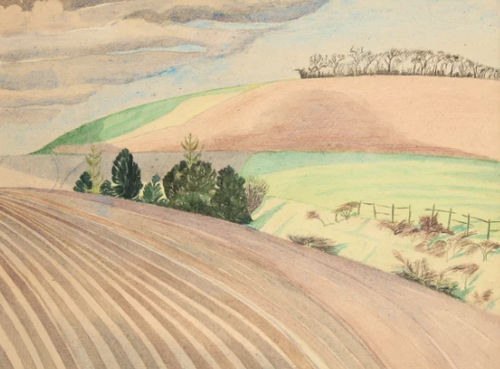
John Nash (1893–1977) was a British painter and engraver renowned for his landscapes, still lifes, and wartime works. Born in London, he didn’t have a formal art education - something he said later in life that he missed out on. But due to his brother (Paul Nash) studying at the Slade - John Nash came across members of the influential Bloomsbury Group, such as Duncan Grant, Dora Carrington, Vanessa Bell and Mark Gertler and became part of the circle of artists who shaped early 20th-century British art.
During the First World War, Nash served in the trenches in France and became an official war artist in 1918 - however he didn't produce any paintings during this time and for the most part the war art he made after active duty was produced from memory.
In 1922 alongside Augustus John, Eric Kennington and Walter Sickert and others, Nash was chosen to represent Great Britain in the Venice Biennale - he then went on to showcase his work at subsequent events over the the years. Nash is particularly celebrated for his sensitive depictions of the English countryside, rendered with clarity, precision, and a quiet, contemplative mood. During both World Wars, he served as an official war artist, producing works that documented the British home front and the natural environment in times of conflict.
He exhibited widely, including at the Royal Academy, and his work is noted for its meticulous observation, subtle tonal variations, and lyrical realism. Today, John Nash is regarded as a significant figure in British landscape painting, admired for his technical skill and evocative portrayals of nature.
