Josef Albers (1888-1976) was a pioneer of abstract painting and theory. Associated with
Minimalist, Conceptual, and Op art movements, the German artist worked across
photography, murals, painting, and screen-printing. Albers's importance to modern art is
attested by his being the first living artist to be given a solo show at MoMa and the MET
(New York).
Albers's formative years were marked by an emphasis on craft and design which balanced the qualities of function and aesthetic, an experience which anticipated and facilitated his artistic career with modernisms.
Following his first job as a teacher in Berlin, Albers moved to Essen to learn stained-glass making. In 1920, Albers enrolled at the Weimar Bauhaus. This institution combined craft and fine art, unifying the ideals of mass production with those of artistic individualism; the Bauhaus created the simultaneously simple yet considered, the functional yet beautiful.
However, in 1933 the Nazis closed the Bauhaus and many artists fled Germany. Albers was
given a means of escape by Philip Johnson, curator of MoMa (New York). He arranged for
Albers - then a teacher at Bauhaus - to run a new artistic institute in Asheville, North
Carolina: Black Mountain College. Albers remained here from November 1933 to 1949,
learning as much, if not more, as he taught.
In 1950, the same year he joined Yale's Department of Design, the 62-year-old Albers began
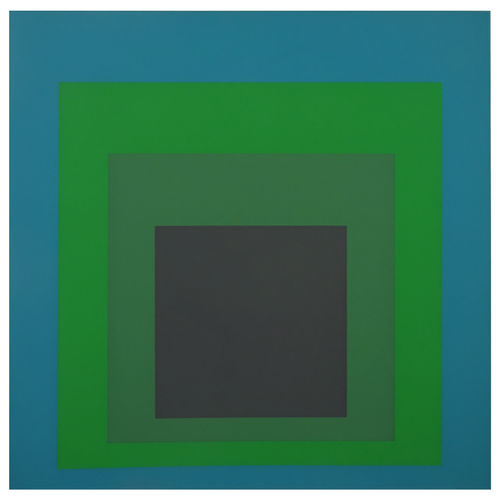
producing works which would constitute his most famous oeuvre: Homage to the Square.
These works - initially paintings, then his favoured screen-prints - consist of three to four
squares of block colours nested within each other and anchored to the work's bottom edge.
These screen-prints encapsulate the development of Albers's artistic thinking from the
Bauhaus to America. His transition across the Atlantic did not replace one artistic approach
with another, but produced a unique synthesis present no other works than his.
As a method and form, screen-printing continued Albers's Bauhaus commitment to
reconciling mass production and artistic individualism.
In aesthetic appearance, they both explored and declared Albers's colour theory, something
with which he became involved in Asheville. Albers's believed that colours are 'the most
relative medium in art', being in a continual state of flux according to context. Thus, the
artist's use of colour must follow their experience of colour. Albers maintained that an
artwork should emerge organically from within itself depending on how its colours interact
to produce aesthetically pleasing and conceptually interesting results.
Albers's screen-prints were born from this trial, error, and experimentation with colour. In
their final form, they encourage the viewer to recognise the deceptive (inter)actions of
colour, thus prompting that viewer into new ways of seeing and new ways - truer ways - of
studying vision. Albers published his colour theory in his controversial Interaction of Color
(1963).
Brooke-Walder's fine collection of these striking screen-prints offers a unique insight into
the revolutionary works, thinking, and life of Josef Albers.
