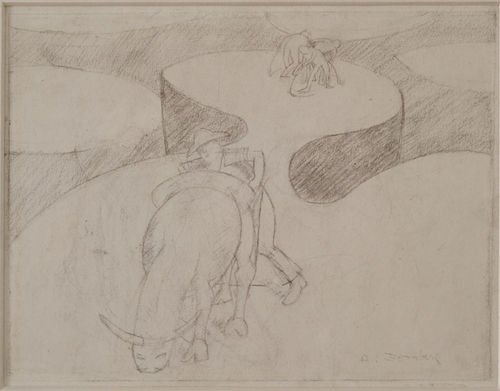
David Bomberg (1890–1957) was a British painter and one of the most dynamic figures in early 20th-century modernism. Born in Birmingham to Polish-Jewish immigrants and raised in London’s East End, he studied at the Slade School of Fine Art, where he emerged as a bold and independent talent.
Initially associated with the Vorticist movement, Bomberg developed a powerful, angular style influenced by Cubism and Futurism. His early works, such as The Mud Bath (1914), are characterized by geometric abstraction and energetic structure. After serving in the First World War, his style shifted toward a more expressive and atmospheric approach to landscape and figure painting.
In later years, Bomberg taught at the Borough Polytechnic (now London South Bank University), where he influenced a generation of artists. Though underappreciated during much of his lifetime, he is now regarded as a major figure in British modern art, known for both his early radicalism and later expressive landscapes.
