BROOKE-WALDER GALLERY
Skip to main content
  • Menu
  • Home
  • Artists
  • Artworks
  • Art Advisory
  • Events
  • Contact
  • About
Menu
Jacob Kramer (1892-1962)

Jacob Kramer (1892-1962)

  • Works
  • Biography
  • Previous artist Browse artists Next artist
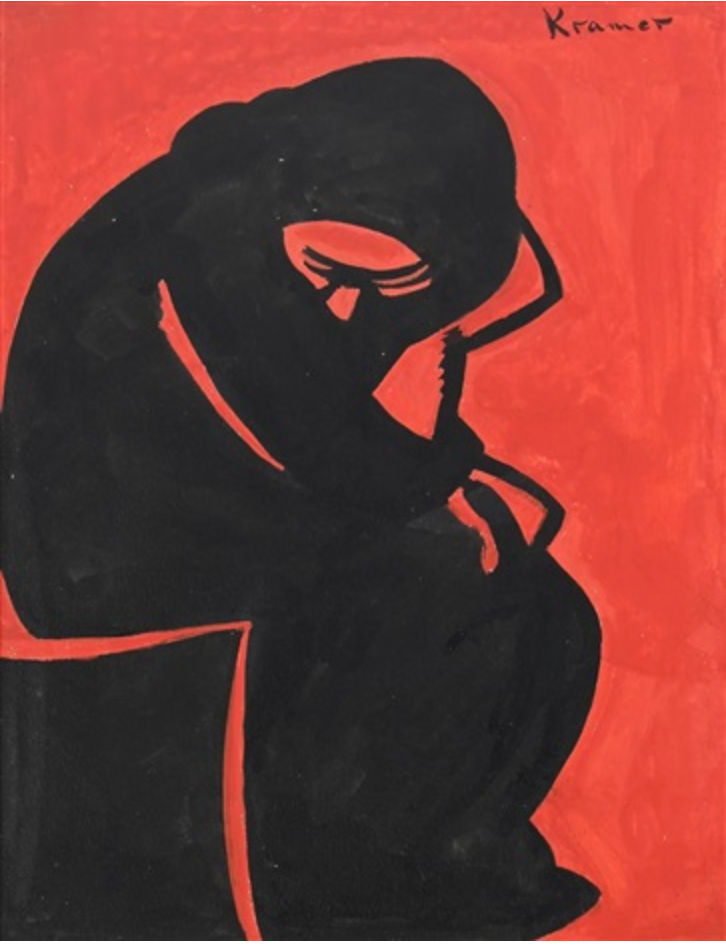
Jacob Kramer (1892-1962), Seated Woman, c.1917

Jacob Kramer (1892-1962)

Seated Woman, c.1917
Gouache with brush, pen and Indian ink
25cm x 18.5 cm Aperture
41.5cm x 35cm Framed
Enquire
%3Cdiv%20class%3D%22artist%22%3EJacob%20Kramer%20%281892-1962%29%3C/div%3E%3Cdiv%20class%3D%22title_and_year%22%3E%3Cspan%20class%3D%22title_and_year_title%22%3ESeated%20Woman%3C/span%3E%2C%20%3Cspan%20class%3D%22title_and_year_year%22%3Ec.1917%3C/span%3E%3C/div%3E%3Cdiv%20class%3D%22medium%22%3EGouache%20with%20brush%2C%20pen%20and%20Indian%20ink%3C/div%3E%3Cdiv%20class%3D%22dimensions%22%3E25cm%20x%2018.5%20cm%20Aperture%3Cbr/%3E%0A41.5cm%20x%2035cm%20Framed%3C/div%3E
After leaving the Slade School of Art in 1914, where he had been a student on a Jewish Educational Aid Society scholarship for one year, Kramer moved in modernist and...
Read more
After leaving the Slade School of Art in 1914, where he had been a student on a Jewish Educational Aid Society scholarship for one year, Kramer moved in modernist and bohemian circles in London. He began showing with progressive artistic groups such as the Vorticists, The London Group and the Allied Artists Association (AAA) and exhibited in David Bomberg, and Jacob Epstein's important Jewish Section at the Whitechapel Gallery's groundbreaking 1914 exhibition 'Twentieth Century Art: a Review of Modern Movements'. He produced a number of highly simplified graphic images at this time, in different media, including gouache, pen and ink, and woodcut, several of which were used as illustrations in contemporary literary and artistic 'little magazines' such as Voices, Rhythm and New Paths. These designs can be seen as experiments with form and colour - one of Kramer's guiding principles, along with expressing the essential spirituality in his work - as he worked towards his most radical Cubist-influenced images, such as his most ambitious oil entitled 'The Day of Atonement' (1919, Leeds Art Gallery), which fused the subject of Jewish religious observance with radical simplification and geometric repetition, and 'The Philosopher' (1922).
Close full details
Share
  • Facebook
  • X
  • Pinterest
  • Tumblr
  • Email


Opening Hours:
Monday to Friday 10am-6pm
Saturday by Appointment

Instagram, opens in a new tab.
Join the mailing list
Send an email
View on Google Maps
Manage cookies
Copyright © 2026 BROOKE-WALDER GALLERY
Site by Artlogic

This website uses cookies
This site uses cookies to help make it more useful to you. Please contact us to find out more about our Cookie Policy.

Manage cookies
Reject non essential
Accept

Cookie preferences

Check the boxes for the cookie categories you allow our site to use

Cookie options
Required for the website to function and cannot be disabled.
Improve your experience on the website by storing choices you make about how it should function.
Allow us to collect anonymous usage data in order to improve the experience on our website.
Allow us to identify our visitors so that we can offer personalised, targeted marketing.
Save preferences
Close

Join our mailing list

Signup

* denotes required fields

We will process the personal data you have supplied in accordance with our privacy policy (available on request). You can unsubscribe or change your preferences at any time by clicking the link in our emails.